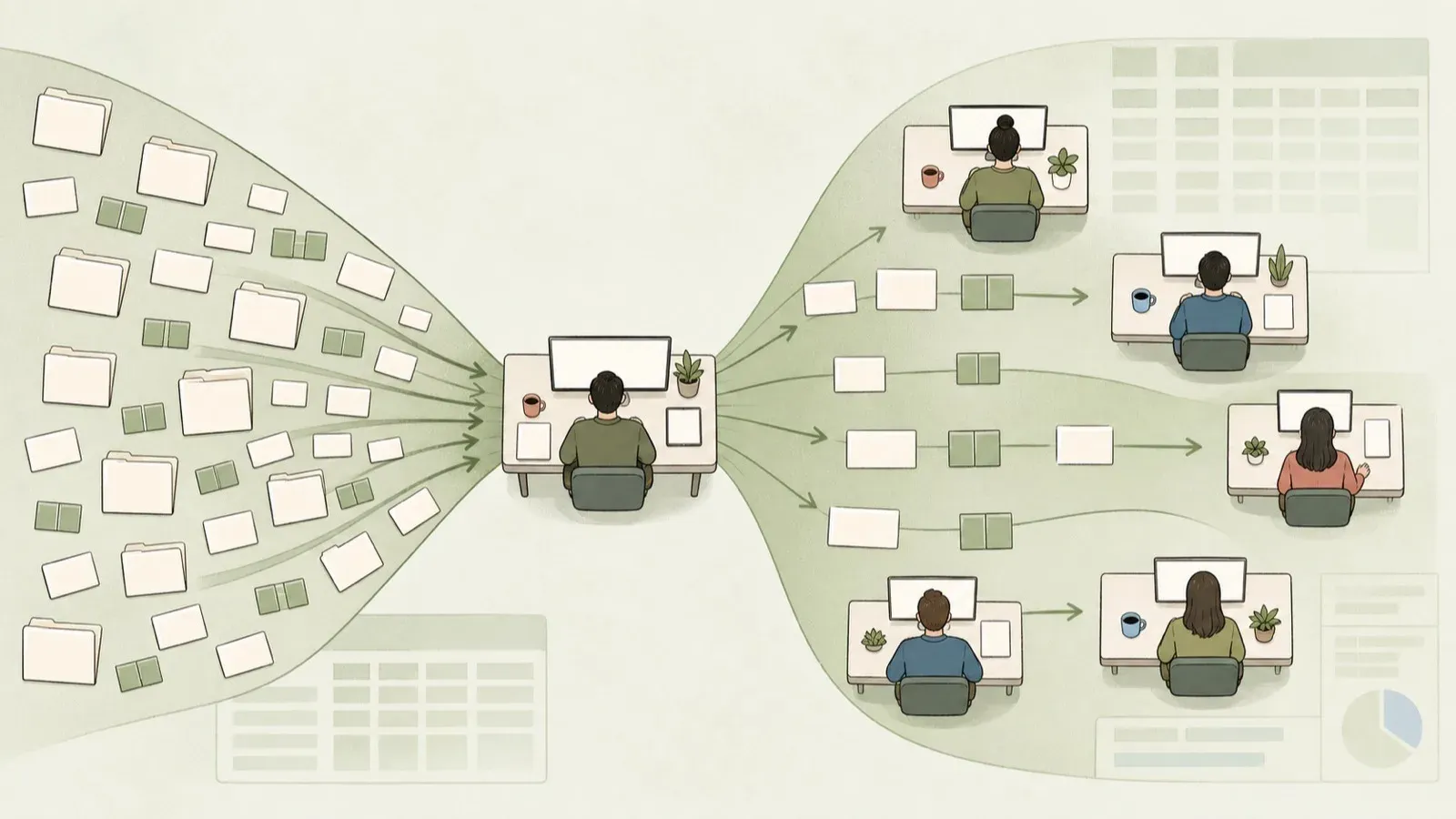
You’ve hired. You’ve onboarded. On paper, the firm has the people it needs. And yet the client emails still default to your inbox, the signoffs still queue behind you, and the moment you take a long weekend the whole thing audibly slows down.
Most owners reading that sentence already know the pattern. What’s harder to see is why it persists in practices that look fully staffed by every other measure. The owner bottleneck isn’t really about hiring or trust or staff capability. It comes down to how work has been designed to flow, and in most small accounting, bookkeeping, legal, and consulting firms, it has been quietly designed to flow through one person.
The most reliable place to spot that design is the team’s timesheets. They show, in a way meetings and check-ins rarely do, where work actually lives.
This isn’t a trust problem. It’s a design problem.
When owners describe the bottleneck out loud, it usually comes out as some version of “I don’t trust them with it yet.” That framing is comforting because it sounds like a stage you’ll eventually grow out of. The trouble is, it almost never resolves on its own. The work itself has been structured to require you.
If a client only ever speaks to you, if every quote and every scope change runs through your reply, if signoff is always your signature, then no amount of staff competence will change the routing. The bottleneck is built into the workflow, not into the relationship between you and your team.
The structural angle matters because it predicts a structural payoff. Research from Gallup found that CEOs with high “Delegator” talent generated 33% more revenue than those with limited delegator talent, and that around three-quarters of employer entrepreneurs scored low or limited on delegation in the first place. The pattern is widespread, and the firms that fix it tend to grow faster, not because the owner becomes a better person but because more of the firm’s hours start producing client value.
This is also where Patrick Accounting lands after twenty years of working with small firm owners: the durable practices aren’t the ones run by owners doing everything themselves. They’re the ones with systems that keep running when the owner is in a meeting, on holiday, or at a client site without a laptop.
So before you look at your team, look at your timesheets. They’ll tell you exactly where the design is broken.
What your team’s timesheets reveal
Timesheet data is unusually honest about who’s carrying the firm. People can underplay their workload in a stand-up. The Time Entries on a Friday afternoon can’t. Four patterns show up consistently when the owner has become the bottleneck.
Concentrated billable hours on the owner’s row
In a healthy small practice, the owner’s billable hours sit somewhere below the senior staff’s. Owners get pulled into business development, hiring, internal process, and the long tail of small admin tasks that don’t bill out. When the timesheets show the opposite, with the owner running 1.5x to 2x the billable load of senior team members across the month, that’s the most direct signal that work isn’t being absorbed by the team.
This one is particularly easy to miss in firms that pride themselves on the owner being “hands-on with clients.” Hands-on is fine. Carrying the highest billable load in a practice of eight is not.
Owner-only client codes
Pull a client list and look at who has time recorded against each one. In most small firms with a bottleneck, you’ll find a cluster of clients whose entries appear on no other timesheet. Sometimes that’s a deliberate strategic call: the most sensitive matters, a high-value retainer, a long-running advisory relationship. More often, it’s accidental. A client started with you, never got handed across, and quietly became a single point of failure.
Owner-only client codes are operational risk in two directions. They concentrate continuity inside one person, and they keep the team from building familiarity with work it could otherwise grow into.
Late or reconstructed entries on the owner’s row
How time gets recorded matters as much as the totals. Staff entries tend to land in real time, or at the end of each day. The owner’s entries, in a bottlenecked firm, often appear in bulk on a Friday afternoon, late on Sunday night, or just before invoicing. They look reconstructed because they are. The work happened in the gaps between everything else, with no time set aside for it.
Reconstruction is its own warning. It means the owner is fitting client work around the practice rather than the other way around, which inflates write-offs, hides scope creep, and quietly breaks the link between time and pricing.
Underutilisation on staff who should be at full capacity
The other side of a concentrated owner row is the staff row that doesn’t fill up. Look at the people who, on paper, should be running close to a normal billable utilisation: experienced bookkeepers, mid-level associates, consultants past their first six months. If their utilisation is chronically under target without an obvious explanation (parental leave, agreed reduced load, a deliberate training period), the cause is almost never a shortage of work. The work just isn’t reaching them.
Underutilisation paired with a concentrated owner row is the clearest operational signature of a bottleneck. Capacity exists. It just isn’t being routed to.
Rebuilding the workflow: observe → recommend → decide → own
Once the timesheets have shown you where the design is broken, the question is how to redesign it without dropping work on the floor in the meantime. The approach that works is to move each piece of work through four sequential stages, each one shifting more of the responsibility off the owner: observe, recommend, decide, and own.
You don’t apply this to everything at once. Pick one client, one workflow, or one decision type, and run it through the sequence over a few weeks or months.
Stage 1: Observe
In the observation stage, a staff member shadows the workflow without taking it over. You keep doing the work (drafting the response, signing off the BAS, reviewing the engagement letter, taking the matter call), but you narrate what you’re doing and why. They sit on the email thread, attend the client call, and watch you make the decision.
The point of this stage is to make the implicit explicit. Much of what owners do for clients is pattern recognition built up over years. Talking it through while doing it is what gets that pattern out of your head and into someone else’s.
Stage 2: Recommend
Next, the staff member proposes the answer before you act. They draft the email, write the recommendation, prepare the file note, or build the quote. You review it, edit if needed, and send it.
Two things matter here. First, you have to use what they produce. If the draft is 80% there and you rewrite it from scratch, you’re back at stage 1 in disguise. Second, give feedback on the draft separately from sending the response, so the next one is closer to ready without needing your input.
Stage 3: Decide
In the decide stage, the staff member makes the call. They send the email. They sign off the reconciliation. They quote the variation. You’re informed afterwards rather than consulted before.
This is the stage most small firm owners skip, and skipping it is what produces the trust gap. The work never moves from “I review it before it goes” to “I find out what was decided,” and the routing through you stays intact. If the decisions sit within an agreed scope and the staff member is experienced enough to make them, this transition has to happen in practice, not just in conversation.
Stage 4: Own
The final stage is when the work no longer routes through you at all. The client deals directly with the staff member. Their name is on the engagement, their signature on the signoff. Your timesheet stops carrying that client. The Dock and Reports show their hours moving into the slot yours used to occupy.
This stage completes the redesign. Until a piece of work reaches “own,” the firm still depends on you for it, even if you’ve delegated everything visible.
What pulls the work back to you
Even with the framework in place, three patterns reliably pull work back onto the owner’s row. They’re worth naming so they’re easier to spot.
The first is the “I’ll just do it faster” loop. Under deadline pressure (year-end, a court date, a project milestone), the owner takes the work back because explaining it would take longer than doing it. That’s true once. Repeated, it’s how stage 4 quietly reverts to stage 2.
The second is the signoff bottleneck. The team makes the decision, drafts the email, prepares the file, and then everything pauses while it waits for your final tick. The work has technically been delegated, but throughput is still capped at your inbox. Pre-agreeing the scope under which staff don’t need signoff is what prevents this.
The third is reverse delegation, where staff bounce decisions back upward. As Jetpack Workflow notes, capacity issues in growing firms usually trace back to bottlenecks, not headcount, and reverse delegation is one of the main ways those bottlenecks reassert themselves. It’s almost always a sign that stage 3 was skipped: the staff member was nominally given decision rights, but the muscle memory of escalating to the owner was never broken.
Closing the loop
The point of all this isn’t that owners stop doing client work. Plenty of owners want to be hands-on, and there’s nothing wrong with that. The point is that the practice stops needing the owner to be there for any specific piece of work to move forward. That’s the difference between a firm of eight and a firm where one person happens to have seven helpers.
Timesheets are how you keep checking. The patterns that produced the bottleneck the first time will produce it again, particularly during onboarding, busy season, or a stretch of new clients. A quarterly look at billable concentration per User and per Contact is enough to catch it early. In MinuteDock, the Dock and the Reports screen surface that view per Contact and per Team member, so the diagnostic doesn’t have to be a project. It can just be something you check when you check anything else.
If your timesheets are already telling you you’re the bottleneck, you don’t need to wait for permission to start the redesign. Pick one workflow. Run it through observe, recommend, decide, own. Watch the row that used to be yours move onto someone else’s.
Start a free MinuteDock trial to see what your team’s timesheets are really showing you.