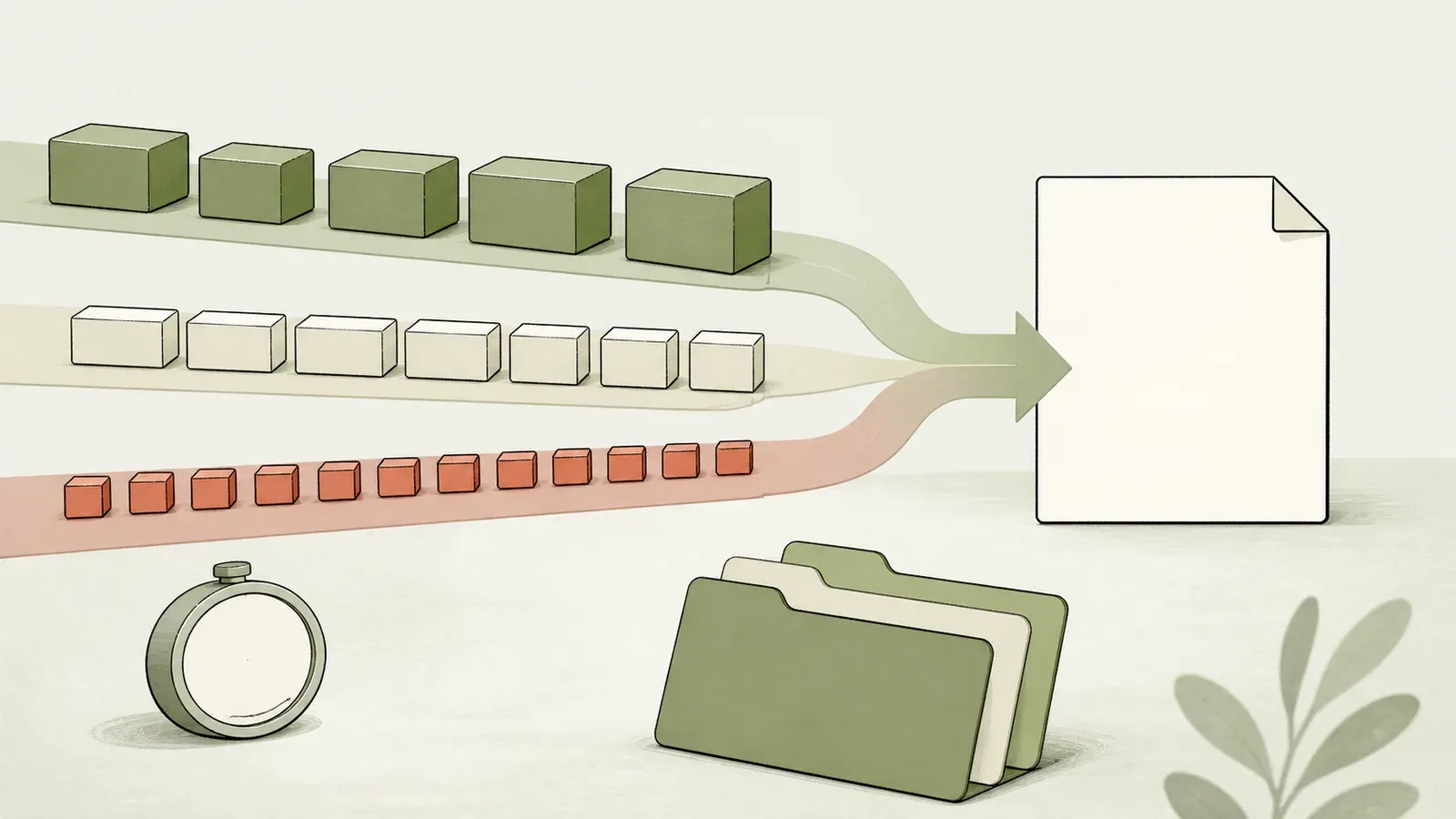
You review a draft invoice. A seven-minute call shows up as 12 or 15 minutes after rounding. That is a billing increment: the block you round tracked time to when it becomes billable, most commonly 6, 10 or 15 minutes. Stack a month of short calls, emails and document reviews and those extra minutes land on the bill.
Decide what gets rounded, when you round it, and whether the billed time matches the work. Write the rule so your team and the client reading the invoice are using the same policy. The charts below convert worked minutes into billable time for each of the three common increments. To look up a single minute, rounded up or to the nearest, use the full minute-by-minute billing increment chart.
What the increment changes
You apply a billing increment when you convert exact tracked time into billable time. Under a round-up policy, you lift each entry to the next block unless it lands on one.
Rounding each entry separately can produce a different bill from grouping related work first, even when the hours worked are the same.
A tenth of an hour is six minutes. A 10-minute increment is one-sixth of an hour, about 0.1667. Those are different intervals, so mixing them changes the bill.
Tenth-of-an-hour chart: 6-minute billing increments
Assumption: round each entry up to the next six-minute block; leave exact multiples unchanged. Each entry can gain 0 to 5 minutes.
| Worked minutes | Billable time | Decimal hours |
|---|---|---|
| 1–6 | 6 min | 0.1 |
| 7–12 | 12 min | 0.2 |
| 13–18 | 18 min | 0.3 |
| 19–24 | 24 min | 0.4 |
| 25–30 | 30 min | 0.5 |
| 31–36 | 36 min | 0.6 |
| 37–42 | 42 min | 0.7 |
| 43–48 | 48 min | 0.8 |
| 49–54 | 54 min | 0.9 |
| 55–60 | 60 min | 1.0 |
Logging time in a spreadsheet? Our free timesheet template that rounds to 6-minute increments applies this chart to every row for you.
10-minute billing increment chart
Assumption: round each entry up to the next 10-minute block; leave exact multiples unchanged. Each entry can gain 0 to 9 minutes. The decimals here are sixths of an hour, not tenths: 10 minutes is roughly 0.1667 hours, shown to two decimal places.
| Worked minutes | Billable time | Decimal hours |
|---|---|---|
| 1–10 | 10 min | 0.17 |
| 11–20 | 20 min | 0.33 |
| 21–30 | 30 min | 0.50 |
| 31–40 | 40 min | 0.67 |
| 41–50 | 50 min | 0.83 |
| 51–60 | 60 min | 1.00 |
15-minute billing increment chart
A 15-minute schedule has four ranges, so it is easy to apply. It also has the largest potential adjustment: a one-minute entry and a 15-minute entry both bill as 0.25 hours under this policy.
Assumption: round each entry up to the next 15-minute block; leave exact multiples unchanged. Each entry can gain 0 to 14 minutes.
| Worked minutes | Billable time | Decimal hours |
|---|---|---|
| 1–15 | 15 min | 0.25 |
| 16–30 | 30 min | 0.50 |
| 31–45 | 45 min | 0.75 |
| 46–60 | 60 min | 1.00 |
Round four related four-minute entries each to 15 minutes and you bill 60 minutes. Group the 16-minute total first and you bill 30. Repeat that across a 20-day month and you have a 10-hour difference.
6 vs 10 vs 15 minutes: how the same day changes
Take five entries of 6, 11, 17, 26 and 44 minutes. Round each one up to the next increment, and leave exact multiples unchanged.
| Tracked time | Exact | 6-minute round-up | 10-minute round-up | 15-minute round-up |
|---|---|---|---|---|
| 6 min | 6 min | 6 min | 10 min | 15 min |
| 11 min | 11 min | 12 min | 20 min | 15 min |
| 17 min | 17 min | 18 min | 20 min | 30 min |
| 26 min | 26 min | 30 min | 30 min | 30 min |
| 44 min | 44 min | 48 min | 50 min | 45 min |
| Total | 104 min | 114 min | 130 min | 135 min |
| Value at $300/hr | $520 | $570 | $650 | $675 |
Repeat that mix across 20 similar days and the gap from exact time is $1,000 with six-minute rounding, $2,600 with 10-minute rounding and $3,100 with 15-minute rounding. Treat those figures as an illustration of the arithmetic, not a typical firm’s month. The five entries are the same 104 worked minutes in every column; the difference in the totals comes from the rounding policy alone.
Keep the policy fair, reasonable and defensible
A string of short entries is where round-up adds the most time. Three two-minute emails become 18 billable minutes if you round each one to six; grouped as one defensible entry, the same six minutes stay at six. Aggregation has to fit the work and the billing instructions. Spell that out in the policy.
Six-minute increments are common in attorney billing, and the American Bar Association describes law-firm billing records as often running to six-minute increments. That is a description of common practice, not a mandate. You still need an increment you can disclose and defend.
For US law firms, ABA Formal Opinion 93-379 says a lawyer billing by time generally may not bill more time than actually spent, except to the extent that the lawyer rounds to disclosed minimum periods such as a quarter or tenth of an hour. The opinion also says the billing basis should be disclosed and the invoice should fairly reflect how charges were determined.
ABA Model Rule 1.5 says legal fees must be reasonable, and the basis or rate should be communicated to the client. Jurisdiction-specific rules and client guidelines may impose further requirements, so treat a general chart as arithmetic rather than permission.
Keep that disclosure standard when tools change how long work takes. MinuteDock’s guide to AI billing ethics for lawyers explains why an hourly invoice should reflect the time actually spent on AI-assisted work rather than the time the task might once have taken.
How to choose a billing increment
Start with the engagement terms and billing instructions. Any mandated increment, restriction on minimums for routine communication or requirement to combine related work outranks the firm’s default. Outside legal billing, accountants, bookkeepers and consultants often work in 15-minute or task-level increments, and client instructions outrank the default there too.
The increment is one part of the policy. Record whether you round up or to nearest, round each entry or an aggregate, use minimums for selected tasks, and review the result before invoicing.
Run your default across a representative week of entries before you switch automatic rounding on, while the entries still hold exact durations. Compare exact duration with the rounded result by client and work type. Check emails, quick reviews, internal updates and unsuccessful calls.
Have someone review invoices. Rounding applies one rule to every entry. A reviewer can catch a mechanically correct result that does not describe the service delivered. Accurate billable-hour tracking, a documented policy and a human check are a stronger combination than rounding alone.
Once the billing quantities are settled, choose how to itemise or group the hours on the invoice. That worked comparison changes the presentation while keeping the billed hours and total unchanged.
For practices leaving hourly billing, the flat-fee versus hourly billing guide explains how tracked time supports pricing and matter profitability even when it no longer appears on the invoice.
Keep your billing policy consistent
Once you have chosen an increment, consistency matters more than complexity. MinuteDock connects time tracking, automatic rounding and invoice preparation, helping your team apply the same billing policy to the work they record.
That means fewer ad hoc calculations and a cleaner path from captured time to invoice review. See how MinuteDock keeps time tracking and billing connected.
Put the policy where clients can see it
A billing-increment policy only needs a few lines: the increment, rounding direction, whether it applies per entry or after aggregation, exceptions and review responsibility. Use the same explanation in engagement material, staff guidance and the billing system.
A policy that needs a string of exceptions is harder for clients to trust on the invoice. Track the work while it is fresh, apply the rule you disclosed, and review the bill before it leaves the practice.