Statement of work template
Agree what you’ll deliver, what your client supplies and what the fee covers.
A free statement of work and separate change request for consultants, accountants and bookkeepers.
Editable Word documents. Printable PDFs and filled examples below.
Choose a document
Edit the Word files in Word or import them into Google Docs. The PDFs are for printing.
Statement of work
A concise agreement covering deliverables, acceptance criteria, client inputs, exclusions, review rounds, dates and payment. Use a fixed fee, hourly rate with a cap, or retainer allowance.
Change request form
A separate one-page form linking a request to the original SOW. Record the scope, hours, fee and date effects, then the decision and acceptance by both authorised contacts.
Two examples you can adapt
Each Word example contains a completed SOW and its approved change request.
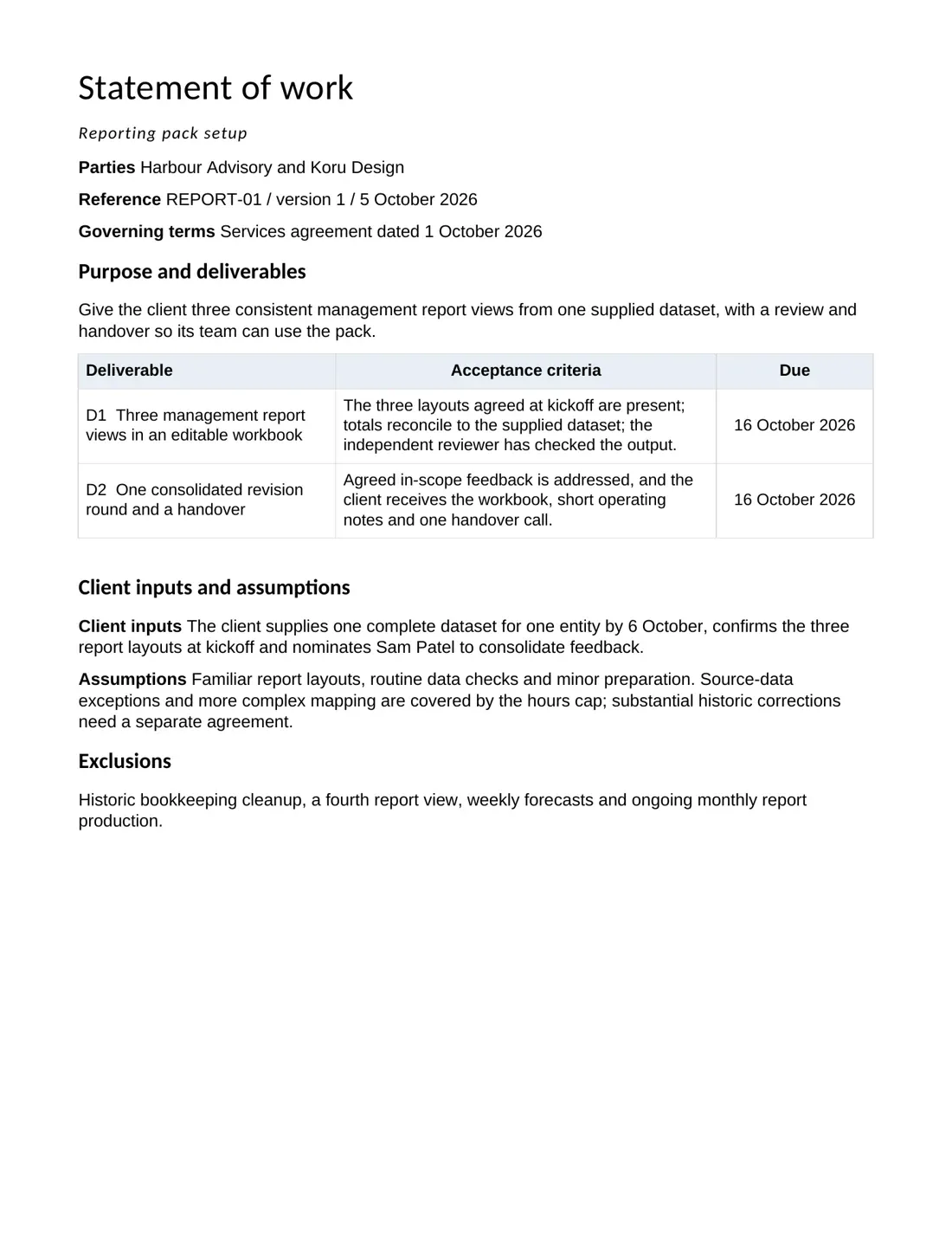
Consultancy: a reporting pack
A capped hourly reporting project, with a change request for an additional report view.
Bookkeeping: a quarterly reconciliation
A fixed-fee quarterly reconciliation, with a change request to add a second bank account.
Questions about scope and changes
- What’s the difference between a statement of work and a scope of work?
The scope describes the work included and excluded. A statement of work brings that scope together with deliverables, responsibilities, acceptance, timing and fees. This template covers both.
- Does this replace an engagement letter or services agreement?
Use it as the project-specific schedule alongside your existing terms. Accounting and bookkeeping practices should tailor their engagement documentation to the services and professional requirements that apply. CPA Australia’s engagement guidance covers scope, responsibilities and fees; ICAEW’s guidance addresses tailoring and changes to agreed terms. This is a starting point, not legal advice. Have your contract terms reviewed for your jurisdiction.
- Where does the delivery work plan fit?
After the scope is agreed, the delivery work plan sets out tasks, owners, dependencies and dates. Its schedule can change without adding client scope. A change to the agreed deliverables, fee or client commitment needs its own agreement.
- Does every change need an extra fee?
No. You might exchange one deliverable for another, reduce the scope, agree a courtesy or change only the date. Record the effect, including a zero fee change, so both sides understand what continues. Corrections needed to meet the existing acceptance criteria belong to the original scope. Our scope-creep guide helps distinguish additional client work from estimating problems and rework.
- When is a change approved?
When the authorised contacts have agreed it through the acceptance process in their existing terms. The form records their decision, dates and written acceptance references or signatures. A request, silence or a pending status does not itself authorise changed work.